
Thoughts On Private vs Public Sector Black Teams

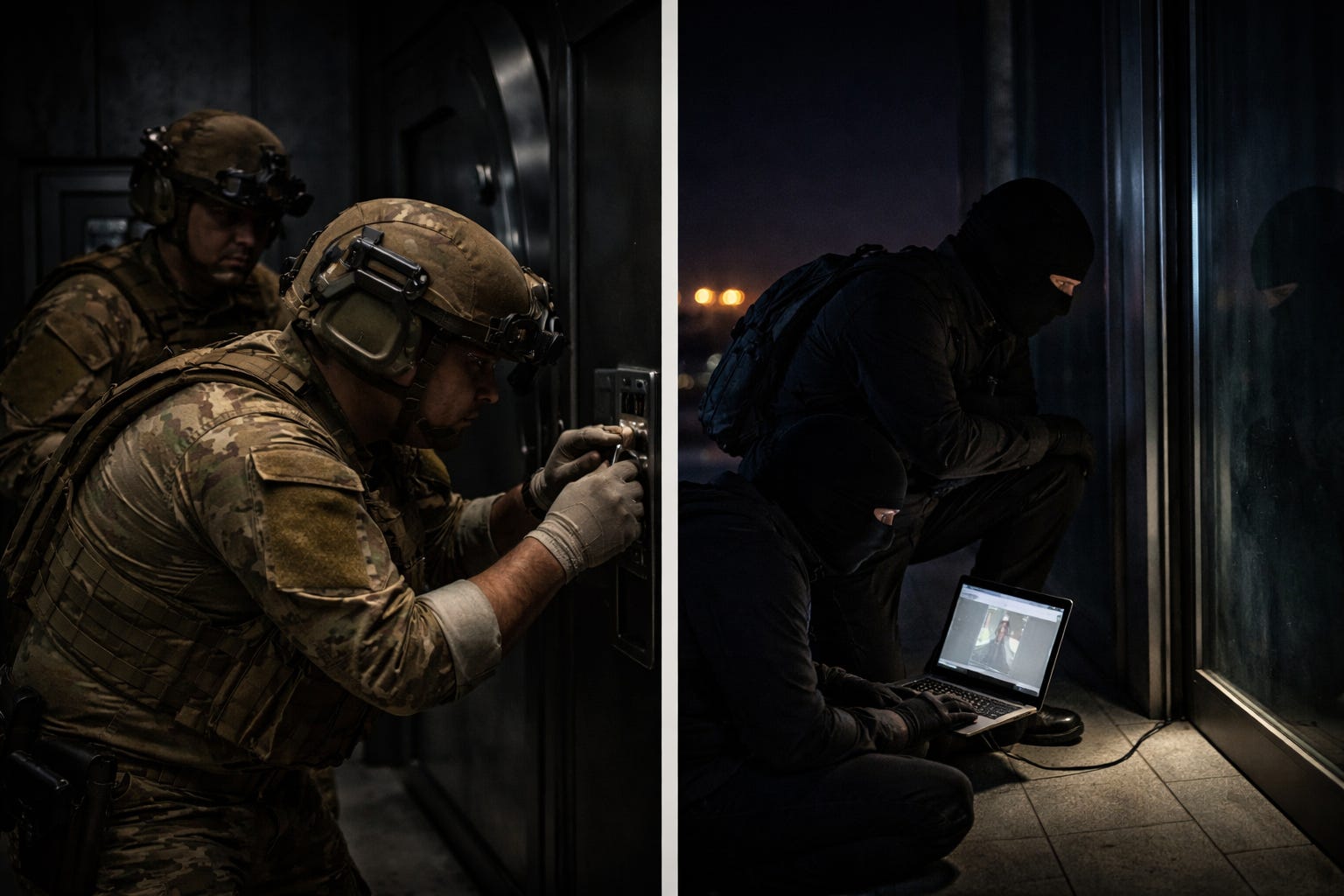
I get asked a lot about some of the pros and cons of working in public vs private sector black teams, and having worked (still do) in both worlds, I thought that I would jump into this topic again. If you want to listen to my thoughts on this, you can listen to a podcast on this topic here.
People on the outside tend to flatten it into one category. A physical penetration team is a physical penetration team. A covert entry job is a covert entry job. A target is a target.
In some ways, this is correct, and you will see a lot of overlap and reoccurring themes throughout different facilities and organizations, but there are also some notable difference.
At a high level, you can say that the private side, for example, usually has the money. The public side usually has the toys, the authorities, the target sets, and the jobs you actually tell stories about years later, if you are ever allowed to tell them at all. One side pays better. The other side hands you access to work that most of the private market will never touch.
Now these are just my personal thoughts on this subject and obviously as such are subjective, but here we go.
The Money vs The Mission

The private side is where the money is. In most cases, your salary will be better, often a lot better, if you decide that you want to work for a private organization
That is not a controversial point. It is just how it goes. Private firms are selling outcomes, billable expertise, reputation, speed, and scarcity. If you are good, the market pays for it.
Public sector work is different. You do not usually go there because it is the best payday. You go there because the job set can get a lot more interesting, a lot more serious, and a lot less available anywhere else.
That is the trade. Less money, better missions.
And for the right person, that trade makes perfect sense.
The Jobs You Really Want

The public sector often gets “the fun jobs”.
By fun, I do not mean easy. I mean the kind of engagements that you will likely be telling stories about years later. High security facilities, often very high security. Places with hardened procedures, layered controls, real active monitoring, and real consequences if you screw up the planning.
A lot of those jobs do not exist in the private market, at least not in the same form. For example, a government entity may want a covert entry assessment but are only authorized to have other government orgs onsite or perform the work. A location that requires all personnel present to have high level security clearances wants an engagement, but … any teammates must have the clearance to physically be there.
Now, this is not me saying that you will not have fun or exciting jobs in the private sector, that isn’t the case at all, I have had more than I can remember. However, if I think back over my career to the engagements with the most opposition, the highest levels of security and the most difficult assignments they are almost all in the public sector.
That is where the public side starts pulling operators in. The salary may be worse, but the work can be more interesting.
Clearances Open Doors

Security clearances are a huge pain in the ass.
They take forever. They are invasive. The higher the clearance, the more friction you deal with, the more scrutiny you deal with, and the longer you can sit in limbo waiting for the machine to finish chewing on your life history.
And remember, with clearances you may be the ideal / perfect / could not be more qualified for the job candidate, but if the clearance says no, you likely wont get the job.
You may go through all the job interviews, get the thumbs up from you future employer and then have to wait literal years for the final ok or rejections … and that is unfortunately not an exaggeration.

Note that it can be significantly more difficult for a private sector employer to get its personnel some clearances, and often they simply wont bother going beyond a certain point or level.
But the tradeoff is real. Higher clearances usually mean access to more interesting jobs, more sensitive targets, and a different class of engagement entirely.
That is one of the big dividing lines between public and private black team work. On the private side, your resume, your skill set, and your reputation open doors. On the public side, those things matter, but the clearance is the thing that has the final say.
Public Sector Resources Are Sometimes in Another League

One of the biggest differences is resources.
Imagine you go to your private employer and say,
“it would be really helpful to my work if you bought every single camera, alarm and PACS on Earth for me to tinker with”
Think raiders of the lost ark warehouse scene but for all things physical security … and better organized.
Now go watch Raiders of the Lost Ark because it deserves everyone to rewatch it.
While this amount of toys can be overwhelming, it is also unparalleled in how useful it can be for training and active engagements. Having effectively a card catalog of access control systems and alarm systems, their capabilities and vulnerabilities that you can pull in real time is invaluable.
You are usually not getting that in the private sector.
Private companies generally do not get to build or buy the same kind of institutional hardware intelligence library that a public organization can justify maintaining over time.
That does not make private teams worse. In a lot of cases it makes them sharper out of necessity, but it does mean the public side can sometimes start the game with better cards in hand.
Time Length of Engagement

Public sector engagements often run longer. Sometimes much longer.
In some cases, they can stretch as long as you need them to, within reason and mission requirements. The point is not to cram the whole operation into the smallest possible contract window. The point is to get the result.
Private sector work usually does not move like that.
Private firms are negotiating with clients. Scope has to be defined. Budget has to be approved. Timelines have to be sold. The engagement window is often as short as possible because someone is paying for every hour and trying to keep legal, operational, and political exposure under control.
That compressed timeline changes behavior and results.

It affects surveillance. It affects reconnaissance. It affects pretext development. It affects how much persistence you can build, how much pattern-of-life work you can justify, how much patience you can afford, and how many iterations you get before the engagement is over.
Public sector work can give you the luxury of time. Private sector work usually demands efficiency.
Both models create good teams, but they reward different strengths.
Public Sector Hours Are Not Your Hours

A lot of people romanticize public sector work without understanding the labor model behind it.
You are effectively on salary. That means there is often no clean line between normal hours and mission hours. If the job needs nights, you work nights. If it needs weekends, you work weekends. If it needs ugly hours, travel, last-minute changes, or long surveillance blocks, that is the job.
There is no serious version of black team work where you are only available from 9 to 5, but public sector work tends to formalize that reality harder. The assumption is often that the mission gets what it needs.
That can be exciting when you are young, hungry, and chasing experience.
It can also grind people into dust.
That isn’t to say that the hours in the private sector are normal or aren’t brutal, but because the public sector jobs tend to last much longer and are much more frequent, it can be grinding.
The Rules Can Kill the Best Option

When you work under a public entity, you often inherit that organization’s safety rules, liability rules, training rules, movement rules, equipment rules, and operational restrictions. Some of those rules make sense. Some are written by people who are never going to be the ones staring at an open access opportunity at 0200.
That matters in black team work because the best path is not always the approved path.

You might find a third-story window cracked open in the middle of the night. Perfect opportunity. Clean angle. Low traffic. In a private context, depending on the scope, your internal policy, and your team’s competence, you might evaluate that route and take it.
In a public sector environment, you may be blocked immediately because the parent organization has a rule saying you cannot scale anything over two stories, or cannot free-climb, or cannot use a certain method without a stack of approvals that do not exist in the moment.
So the route is dead, not because it is impossible, but because the bureaucracy reached the window first.
That is one of the more frustrating parts of public side black team work. You may have more target access, more time, and better institutional support, while simultaneously being handcuffed by rules written to protect the organization from risk rather than help the operator exploit opportunity.
It is part of the job, but it is still annoying.
How Often You’ll Actually Be Doing the Work

One of the biggest differences that doesn’t get talked about enough is how often you’re actually out there doing the job.
On the public side, this is your job. It’s a full-time role focused on offensive operations, and you should expect to be doing it constantly. Planning, recon, execution, reporting, rinse and repeat. There’s very little downtime where you’re not directly tied to an active or upcoming engagement.
You build instinct, speed, and confidence because you’re doing the work over and over again in real environments. But it also means you don’t really get a break from it. The work can be physically demanding, mentally draining, and sometimes just exhausting, especially when you’re stacking long nights, surveillance, weird hours, and back-to-back operations.

On the private side, it’s usually very different.
Physical pentesting is often not the primary revenue driver for a company, especially early on. So you may not be doing it all the time. In many cases, you’re hired as something adjacent, maybe a cyber pentester, red teamer, or consultant, and physical work is something you offer when the opportunity comes up.
That means fewer engagements, sometimes much fewer.
You might go weeks or months without a physical job, then suddenly have one, then back to normal work again. As the service matures inside the company and demand grows, those opportunities can become more frequent, but it’s rarely as constant as the public side.
There’s a trade-off here.
On one hand, you don’t get the same volume of reps, which can slow down skill development if you’re not actively training on your own. On the other hand, you also avoid the burnout that can come from doing this kind of work non-stop.
Because while these jobs are fun, and they are, they’re also taxing. Long hours, awkward positions, physical strain, high focus, and constant problem solving. Doing that occasionally is exciting. Doing it continuously, without much downtime, can wear you down faster than people expect.
Now all of that said, I strongly encourage anyone in the private sector to work with their sales team to help the client understand black teaming, how they work and what their value is. In the link above, you can find an entire post about how to help your sales team sell more engagements.
Final Thoughts
Public and private black team work sit under the same banner, but they are built around different incentives.
The private side pays better. The public side often gives you more frequent engagements and higher stakes assignments. One gives you market freedom. The other gives you target access. One is shaped by contracts, the other by authorities, clearances, and bureaucracy.
As Thomas Sowell accurately says,
“There are no solutions. There are only trade-offs.”
You can absolutely have an exciting career in either sector, but as I often get asked about the differences, I thought i would write up my thoughts on the matter.
Hopefully this helps or at least was interesting to readers. Regardless as to where you find yourself in the field, I hope you’re all enjoying it and we get to hear about your stories in the future
Training Resources:
For individuals looking for a hands on training that includes all of the above topics, Covert Access Team (covertaccessteam.com) provides training courses focused on physical penetration testing, lockpicking, bypassing techniques, social engineering and other essential skills.
Covert Access Training - 5 day hands on course designed to train individuals and groups to become Covert Entry Specialists
Physical Audit Training - 2 day course on how to setup and run a physical security audit
Elicitation Toolbox Course - 2 day course of that primarily focuses on elicitation and social engineering as critical aspects of Black Teaming
Strategic Operations for Lone Operators - Advanced course for those who are interested in learning how to become a one man infiltration team.
Counter Elicitation - 2 day course on how to recognize and prevent elicitation attempts, and safegaurd your secrets.
Cyber Bootcamp for Black Teams - 2 day course designed explicitly for physical penetration testers who need vital cyber skills to add to their toolbox.
Private Instruction - Focused learning & training based on your needs .